
What Are the Different Types of Manufacturers? OEM, ODM, and EMS Explained
inChoosing a manufacturing partner involves more than comparing price and production capacity. The decision also affects product design, engineering, customization, intellectual property ownership, manufacturing, and lifecycle support.
OEMs, ODMs, and EMS providers assign these responsibilities differently, but the terminology varies across industries and suppliers. This guide explains how these manufacturing models differ, when each model is appropriate, what can be customized, and how to evaluate a potential partner before moving from concept to volume production.
What Are OEM, ODM, and EMS?
At a high level, an OEM-oriented supplier builds according to a customer-defined design or specification, an ODM provides an existing product platform or takes greater responsibility for product design, and an EMS provider focuses primarily on electronics manufacturing, sourcing, assembly, testing, and production support.
What Is an Original Equipment Manufacturer (OEM)?
OEM stands for Original Equipment Manufacturer, although its meaning varies by industry. In this article, OEM manufacturing refers to a model in which the customer retains greater control over the product concept, specifications, and technical direction, while the manufacturing partner supports sourcing, production engineering, assembly, testing, and quality control.
An OEM program may begin with a complete customer-owned design, a specification requiring engineering refinement, or a product developed jointly with the manufacturing partner. Design ownership, deliverables, and modification rights should always be defined in the manufacturing agreement.
What Is an Original Design Manufacturer (ODM)?
ODM stands for Original Design Manufacturer. An ODM takes greater responsibility for product design and may adapt an existing platform or develop a more extensively customized product.
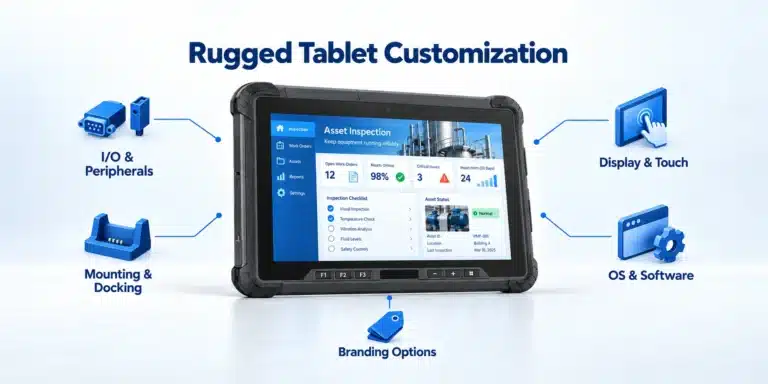
Customization can include the processor, memory, storage, display, connectivity, I/O, mechanical design, firmware, operating system, software, accessories, and branding. Starting with an existing platform can reduce development time and technical risk, but the feasible scope depends on volume, budget, certification, and lifecycle requirements.
The ODM may retain ownership of the underlying platform while the customer owns agreed application-specific modifications, software, tooling, or branding. These rights should be defined contractually.
What Are Electronics Manufacturing Services (EMS)?
EMS stands for Electronics Manufacturing Services. An EMS provider generally manufactures a substantially completed customer design rather than supplying a complete product platform.
Typical services include component sourcing, PCB and system assembly, production testing, quality inspection, packaging, logistics, repair, and supply-chain support. Some EMS providers also offer engineering services, so their capabilities may overlap with OEM or ODM suppliers.
The key consideration is therefore not the supplier’s label, but the specific design, engineering, manufacturing, and lifecycle responsibilities it accepts.
Where Do White Label and Private Label Fit?
White label and private label describe branding and commercial arrangements rather than complete manufacturing models. Both can sit on top of OEM, ODM, or hybrid relationships, but the terms do not by themselves define who designed the product, who owns the intellectual property, or how much customization is available.
A white-label product is typically a mature, standardized platform that can be offered to multiple customers under different brand names. Customization is usually limited to branding, packaging, software configuration, accessories, and selected product options.
A private-label product is generally supplied for a specific customer or brand and may involve a more differentiated configuration. Depending on the agreement, it can include exclusive features, mechanical changes, software integration, custom accessories, or commercial restrictions.
In practice, either model may use an ODM platform. The important questions are how much customization is required, which party owns the design and tooling, whether exclusivity applies, and what engineering and manufacturing responsibilities the supplier accepts. If you are evaluating a commercial program, explore Estone’s white-label manufacturing services or private-label manufacturing services.
OEM vs. ODM vs. EMS: Key Differences
The differences between OEM, ODM, and EMS are mainly based on product maturity, design responsibility, engineering involvement, manufacturing scope, and ownership.
| Dimension | OEM | ODM | EMS |
| Starting point | Customer design, specification, or product concept | Existing platform or ODM-led design | Customer-developed design or manufacturing package |
| Product design | Primarily customer-led or jointly developed | Greater ODM responsibility | Usually limited to manufacturing-related engineering |
| Intellectual property | Commonly customer-owned, subject to contract | May be ODM-owned, customer-owned, or shared | Usually remains with the customer |
| Customization | Based on the customer’s design and requirements | Platform configuration through full custom development | Primarily manufacturing, sourcing, assembly, and testing |
| Engineering involvement | Varies by supplier and project | Typically extensive | Usually focused on manufacturability and production |
| Development time | Depends on the maturity of the customer design | Can be shorter when using an existing platform | Depends on the readiness of the manufacturing package |
| Initial investment | May require significant customer engineering and tooling | Depends on platform reuse and customization depth | Primarily manufacturing setup and production engineering |
| Typical customer | Company with an established design or strong engineering resources | Company that needs a product platform and development support | Company with a completed design ready for production |
| Lifecycle support | Depends on the manufacturing agreement | Often integrated into the platform relationship | Frequently includes sourcing, production, repair, and logistics |
These are general patterns rather than fixed legal definitions. A supplier may combine OEM, ODM, and EMS capabilities within the same organization or project. For a visual summary, see our OEM, ODM, and EMS infographic.
Which Manufacturing Model Fits Your Project?
The appropriate model depends on what the customer already has, what still needs to be developed, and how much responsibility the manufacturing partner is expected to assume.
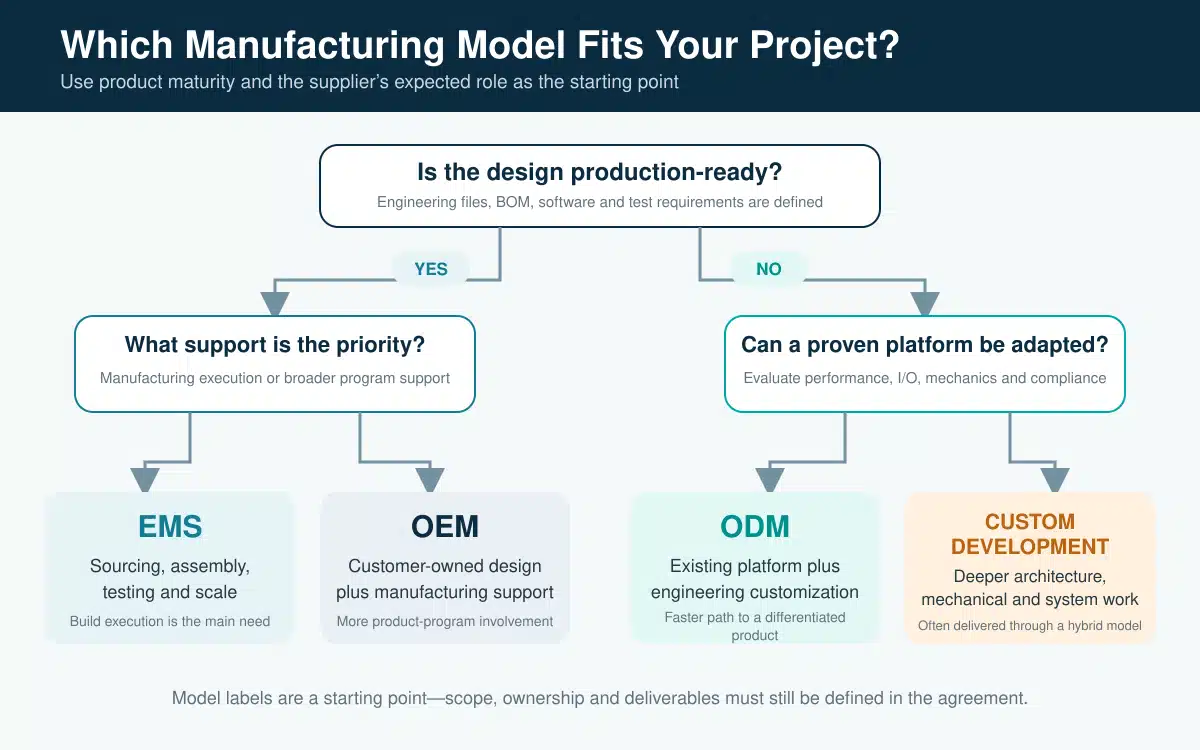
Choose a Build-to-Print or Contract Manufacturing Model When You Have a Mature Design
Best when: Your company already has a mature product design, defined architecture, engineering files, mechanical and electronic designs, a bill of materials, software or firmware, test requirements, and certification plans.
Manufacturing partner focus: Component sourcing, production engineering, assembly, testing, quality control, packaging, and delivery.
In many industries, the OEM is the company that owns the product brand and design rather than the external manufacturer. When a supplier manufactures a customer-owned design, the relationship may therefore be described more precisely as build-to-print or contract manufacturing, even if the supplier markets the service as OEM manufacturing.
The supplier may recommend component substitutions, design-for-manufacturing improvements, test changes, or mechanical adjustments, but the customer generally retains greater control over the product design and technical direction.
Choose an ODM Model When You Need a Product Platform and Engineering Support
Best when: Your company understands the market need and intended application but does not yet have a complete production-ready product design.
ODM partner focus: Platform selection, system architecture, processor and display configuration, connectivity, I/O, integrated peripherals, mechanical design, thermal management, operating-system configuration, environmental protection, docking, charging, and certification preparation.
A customer may know that it needs a rugged tablet, medical computing platform, industrial panel PC, specialized controller, or another application-specific device but still require engineering support to turn those requirements into a manufacturable product.
Beginning with an existing ODM platform can reduce development time and technical risk while preserving flexibility for application-specific differentiation. When an existing platform cannot meet the requirements, a more extensive ODM program may include new electronic, mechanical, or industrial design.
Choose an EMS Provider When the Product Is Ready for Manufacturing
Best when: The product design and manufacturing package are substantially complete, and the primary requirement is manufacturing execution.
EMS provider focus: Component procurement, PCB assembly, final product assembly, production testing, quality inspection, packaging, logistics, repair services, and supply-chain coordination.
An EMS provider may also help improve manufacturability, testability, production yield, and sourcing. However, it does not necessarily define the product or provide a reusable product platform.
Consider White Label or Private Label When Speed Is the Main Priority
Best when: Speed to market and reduced development investment are more important than extensive product differentiation.
Typical scope: Branding, packaging, software configuration, selected product options, accessories, and limited mechanical or commercial customization.
Before selecting this model, customers should confirm which configurations are available, whether hardware and software changes are permitted, whether the platform is offered to other brands, whether regional or market exclusivity is available, who owns the certifications and technical documentation, and how long the platform will remain available.
Many Projects Use a Hybrid Model
Real projects do not always fit into a single category. A customer may start with an ODM platform, provide its own software, request custom mechanical components, and rely on the same partner for manufacturing and lifecycle support. Another customer may own the complete product design but ask the manufacturing partner to redesign selected subsystems. The agreement should describe the actual responsibilities rather than relying only on the terms OEM, ODM, or EMS.
What Should Customers Define Before Contacting a Manufacturer?
Clear requirements reduce development risk, shorten decision-making, and allow potential partners to evaluate feasibility more accurately.
| Requirement Area | What to Define |
| Intended Application and Users | Identify who will use the product, where it will be installed or operated, and whether it will be handheld, vehicle-mounted, wall-mounted, docked, or embedded. Also define how frequently the product will be moved, charged, cleaned, shared, or serviced. The intended workflow can affect the display, controls, ports, battery, enclosure, accessories, and software. |
| Operating Environment | Define indoor or outdoor use, temperature range, exposure to water, dust, humidity, chemicals, shock, vibration, drops, electromagnetic interference, cleaning agents, sunlight, gloves, and water on the touchscreen. Establish the required IP rating and applicable shock, vibration, and drop requirements based on the actual operating conditions. |
| Functional and Performance Requirements | Document processor and graphics requirements, memory, storage, display size and resolution, touchscreen technology, cameras, audio, battery runtime, wired and wireless connectivity, data-capture modules, sensors, security, external peripherals, and application-specific interfaces. Separate mandatory requirements from preferred features. |
| Software and System Integration | Define the operating system, BIOS, firmware, drivers, system image, boot behavior, application environment, UI/UX, device management, remote monitoring, update mechanisms, security policies, data protection, and compatibility with existing peripherals or enterprise systems. Responsibility for software development, validation, maintenance, and long-term support should also be assigned. Learn more about Estone’s software development services for OEM/ODM platforms. |
| Certification and Target Markets | Identify where the product will be sold and used. Determine the applicable regulatory, safety, EMC, wireless, environmental, medical, automotive, military, or industry-specific requirements before finalizing the architecture and components. Defense applications may also require testing to standards such as MIL-STD-461G. |
| Commercial and Lifecycle Requirements | Define expected annual volume, initial pilot quantity, target cost, development budget, launch schedule, expected product lifetime, forecasting process, warranty, repair, packaging, logistics, and component-availability expectations. |
| Ownership and Change Control | Clarify ownership of the underlying platform, newly developed elements, design files, tooling, software, source code, certifications, and technical documentation. Also define exclusivity, confidentiality, approval authority, modification rights, and engineering change procedures. |
What Can Be Customized in an ODM/OEM Computing Project?
Customization can range from configuring an existing product to developing a completely new computing platform.
| Customization Area | Typical Options |
| Computing Performance | Processor platform, memory, storage, graphics or AI acceleration, thermal design, power architecture, and hardware security. |
| Display and User Interaction | Display size and resolution, brightness, optical bonding, anti-reflective or anti-glare treatment, touchscreen technology, glove and wet-touch operation, physical controls, operator interface, and stylus support. |
| Connectivity and I/O | USB, Ethernet, serial ports, CAN bus, GPIO, HDMI or DisplayPort, Wi-Fi, Bluetooth, cellular connectivity, GNSS, RFID, NFC, barcode scanning, smart card or CAC readers, cameras, and sensors. Interface requirements should be evaluated together with mechanical space, power consumption, driver support, antenna design, and environmental sealing. |
| Mechanical and Environmental Design | Enclosure dimensions, materials, color, mounting points, port locations, connector protection, handles, carrying features, docking interfaces, cooling, environmental sealing, impact protection, branding, and labeling. Mechanical changes may affect tooling, sealing, thermal performance, certification, and production cost. |
| Firmware, Operating System, and Software | BIOS configuration, firmware, Windows, Linux, Android, or another operating environment, drivers, system image, boot behavior, security settings, device management, application integration, and update mechanisms. |
| Deployment and Accessories | Desktop docking, vehicle docking, wall mounting, charging systems, replaceable batteries, carrying accessories, custom cables, packaging, and installation materials. |
From Requirements to Volume Production
A structured development process helps ensure that the final product can be manufactured consistently and supported throughout its intended lifecycle.
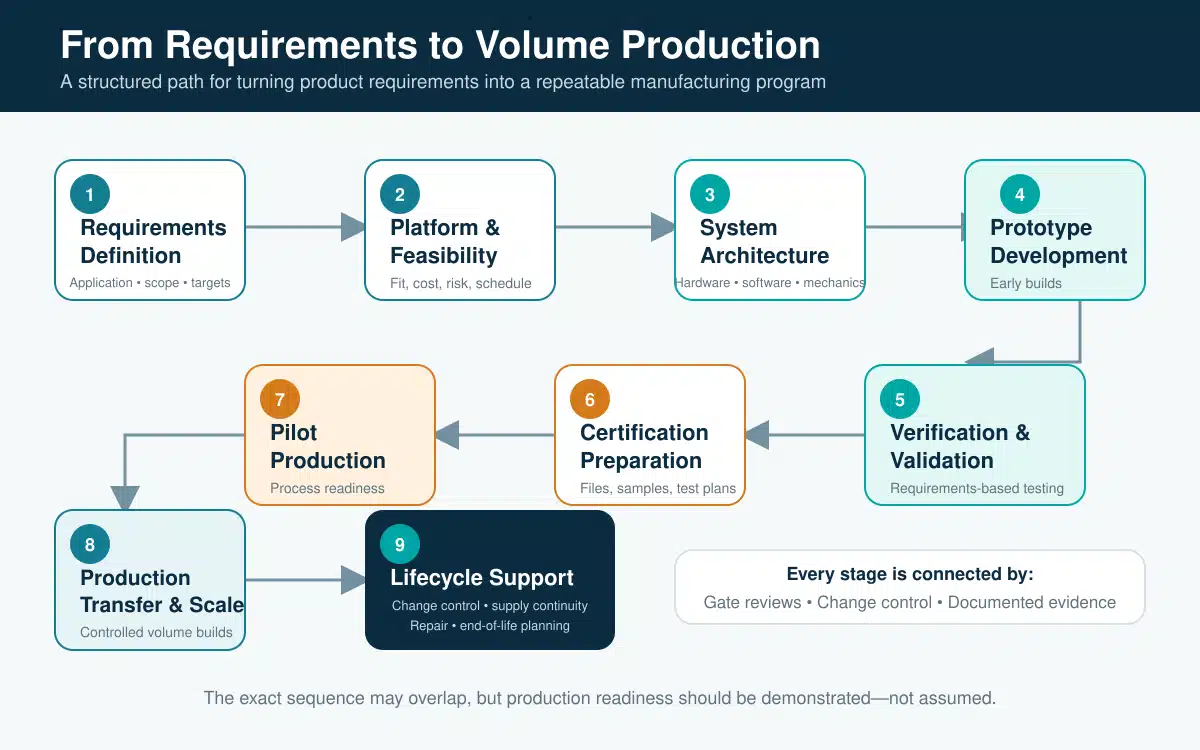
Phase 1: Define and Design
1. Requirements Definition: The customer and manufacturing partner define the intended application, technical requirements, operating environment, compliance needs, budget, schedule, and production expectations. Unresolved assumptions should be identified before major design work begins.
2. Platform Selection and Feasibility Review: The manufacturing partner evaluates whether an existing platform can meet the requirements or whether deeper customization is necessary. The review should consider technical performance, mechanical constraints, component availability, software compatibility, certification, development cost, schedule, and expected production volume.
3. System Architecture and Design: The team defines the hardware architecture, mechanical structure, interfaces, software environment, peripherals, power system, thermal approach, and production strategy. Design responsibilities and required deliverables should be assigned to the appropriate party.
Phase 2: Prototype and Validate
4. Prototype Development: Early prototypes are used to evaluate appearance, ergonomics, interfaces, system behavior, and application integration. The purpose of each prototype should be clearly defined because cosmetic samples, engineering prototypes, and production-representative units may use different materials, tooling, and components.
5. Verification and Validation: The product is evaluated against documented requirements, including functional performance, software compatibility, mechanical fit, thermal behavior, battery performance, environmental protection, touchscreen operation, wireless performance, EMC preparation, and application-specific testing. Identified issues should be tracked to closure before production release.
6. Certification Preparation: Certification samples, technical files, labeling, component documentation, test plans, and product configurations should be aligned before product testing and certification. Because certification generally applies to a defined configuration, uncontrolled component or design changes may require additional review or testing.
Phase 3: Scale and Support
7. Pilot Production: A pilot build evaluates whether the product can be manufactured consistently using the intended production process. The team reviews assembly procedures, test coverage, work instructions, component traceability, production yield, quality issues, packaging, repair procedures, and operator feedback.
8. Production Transfer and Volume Manufacturing: After the design and manufacturing process are approved, the project moves into controlled production. Production documentation, approved suppliers, test fixtures, inspection criteria, change-control procedures, and quality records should be maintained throughout the program.
9. Lifecycle and Post-Production Support: Long-term support may include component-availability monitoring, alternative-component qualification, firmware and software maintenance, engineering changes, warranty repair, spare parts, product updates, and end-of-life planning. Lifecycle planning is especially important for products expected to remain in service for several years.
Common OEM/ODM Project Risks—and How to Control Them
| Project Risk | How to Control It |
| Incomplete or Changing Requirements | Conflicting assumptions can develop when requirements remain unclear. Maintain an approved requirements document, separate mandatory and optional features, and define how changes will be reviewed and approved. |
| Unclear Intellectual Property Ownership | Unclear ownership can create disputes involving design files, software, tooling, certifications, and future product modifications. Define ownership, licensing, access, exclusivity, and transfer rights before major development begins. |
| Uncontrolled Customization Scope | Additional features can increase cost, delay validation, affect mechanical design, and introduce new certification requirements. Use formal scope control and evaluate the system-level impact of every proposed change. |
| Certification Requirements Identified Too Late | Late certification planning may require component substitution, PCB changes, enclosure redesign, shielding, software changes, or additional testing. Identify target markets and applicable requirements during feasibility review. |
| Prototypes That Do Not Represent the Production Design | A successful prototype does not automatically prove that the production product is ready. Document differences between prototype and production configurations and complete validation on representative hardware. |
| Component Availability and Obsolescence | A technically suitable component may not support the required production volume or product lifecycle. Review availability, lead times, supplier status, lifecycle information, and alternative parts during design. |
| Insufficient Environmental and Application Testing | Passing a basic bench test does not demonstrate performance in the intended operating environment. Validation should reflect real handling, installation, peripherals, software, environmental exposure, and operator workflows. |
| Weak Production Transfer | A design may function correctly but still be difficult to manufacture consistently. Production transfer should include controlled documentation, assembly instructions, test procedures, quality criteria, training, and pilot-build review. |
| Poor Change Management | Uncontrolled changes can create inconsistent product configurations and invalidate previous testing. Hardware, software, component, and production changes should follow a documented approval and traceability process. |
Moving from Pilot Builds to Volume Production
The transition from pilot production to volume manufacturing requires more than approving a functional sample. Production readiness should be evaluated across three areas.
Product Readiness
Confirm that product requirements are complete, the approved design configuration is controlled, the bill of materials is released, pilot-build issues have been resolved, and applicable validation and certification activities are complete.
Manufacturing Readiness
Confirm that critical suppliers are approved, manufacturing documentation is released, test fixtures and production software are ready, inspection criteria are defined, work instructions are available, and production yield has reached an acceptable level.
Support Readiness
Confirm that packaging and logistics have been validated, repair and warranty procedures are available, engineering change control is active, and component lifecycle risks are being monitored.
Production readiness should be based on documented evidence rather than schedule pressure alone.
Questions to Ask a Potential Manufacturing Partner
Before selecting an OEM, ODM, or EMS partner, consider asking:
- Which parts of the product design will the customer own?
- What customization is supported on the proposed platform?
- Which engineering work is included, and which work requires additional fees?
- How will design changes be documented and approved?
- Which certifications already exist, and which tests must be repeated?
- How are components, suppliers, and product revisions controlled?
- What happens if a critical component becomes unavailable?
- How are pilot production and mass-production readiness evaluated?
- What warranty, repair, and failure-analysis services are available?
- How long can the product and its major components be supported?
The answers should be documented in the project scope or manufacturing agreement.
How Estone Supports Custom Computing Programs
Estone supports companies developing rugged, medical, industrial, and application-specific computing systems.
Depending on the project, customers can begin with an existing Estone platform or evaluate a more extensively customized solution. Potential areas of configuration and development include computing performance, display and touch technology, connectivity, I/O, wireless modules, data-capture peripherals, mechanical design, docking, charging, operating-system configuration, firmware, software integration, branding, validation, and production support.
We can support programs from early platform selection and feasibility review through prototyping, validation, production transfer, volume manufacturing, and lifecycle planning. The appropriate approach depends on the customer’s technical requirements, intended application, development resources, target volume, certification needs, schedule, and product-lifecycle expectations.
Learn more about Estone’s ODM/OEM design and manufacturing services.
FAQs
Q1: What Is the Main Difference Between OEM and ODM?
In an OEM-oriented project, the customer usually provides more of the product design, specification, or technical direction. In an ODM project, the manufacturing partner generally provides an existing platform or takes greater responsibility for product design and development. The exact responsibilities and ownership arrangements depend on the contract.
Q2: What Is the Difference Between an OEM and a Contract Manufacturer?
In many industries, the OEM is the company that defines, owns, and markets the final product. A contract manufacturer produces the product, component, or assembly according to the customer’s design and manufacturing package. However, some suppliers use “OEM manufacturing” to describe build-to-print or customer-directed manufacturing services. Because terminology varies, companies should define design ownership, engineering responsibility, production scope, and intellectual property rights in the project agreement.
Q3: What Is the Difference Between ODM and EMS?
An ODM provides a product design or reusable product platform and may support customization, engineering, manufacturing, and lifecycle management. An EMS provider typically focuses on electronics manufacturing, assembly, sourcing, production testing, logistics, and repair based on a customer-provided design. Some companies provide both ODM and EMS capabilities.
Q4: Who Owns the Product Design in an ODM Project?
Ownership depends on the development arrangement. The ODM may retain ownership of its underlying platform, while the customer owns branding, application software, tooling, or customer-specific modifications. A custom-developed design may be owned by the customer, ODM, or both parties according to the agreement. Ownership and usage rights should be defined before development begins.
Q5: Is ODM Faster Than Developing a Product From Scratch?
It can be. Using an existing ODM platform may reduce architecture, engineering, prototyping, and validation work. However, extensive hardware changes, new tooling, certification, or application-specific software can still require a significant development program. The actual schedule depends on the depth of customization and the maturity of the starting platform.
Q6: How Should a Company Choose an OEM or ODM Partner?
Evaluate the supplier’s experience with your product category, engineering capabilities, platform maturity, quality system, production capacity, testing resources, certification experience, supply-chain controls, communication process, lifecycle support, and willingness to define responsibilities clearly. The best partner is not necessarily the company offering the lowest initial price. It is the partner that can support the product’s technical, commercial, production, and lifecycle requirements with an acceptable level of risk.